Showing posts with label WSBK. Show all posts

Wednesday, August 7, 2013

Social Media, What's That?


Social media has become a huge part of our lives, particularly if you are running a business. In many cases social media sites and services such as Facebook, Twitter and Instagram provide an excellent source of free marketing and exposure. In a clothing store I overheard that 80% of their business came from Instagram. An amazing statistic for a free service not even intended to be used as advertising.  

These services not only provide free exposure but also bring, or enhance, the personality of a business, product or person. Dorna uses Twitter and Instagram to great effect with MotoGP, not only is news posted there and links to videos on their website provided but funny little things, like the Cal – Marquez Parc Ferme ‘incident’ are also posted. Not only does this give a chance to have these photos and videos seen by a new audience, but small things like this show that even a big company like Dorna has a sense of humor, making it seem friendly. And we all like friends, right? Actions like this may seem small but go a long to keeping current fans and improving the overall image of the brand, even with photos like Cal’s and Marc’s that are a bit, questionable.

Considering all of this it’s a huge surprise that a global series like World Superbike has almost no social media presence. The name ‘WSBK’ on Instagram belongs to someone named ‘Wendy’ with zero followers or photos. Furthermore the WSBK Twitter links mostly to race reports and rider interviews, in text, on their website. Obviously there are some photos of riders and paddock personalities doing silly things but overall it’s a very dry affair.

The World Superbike championship has a lot of problems on and off the track, but social media, or lack thereof, seems a very simple thing to fix in the grand scheme of it all. But instead the championship lags behind and struggles, confusing when WSBK and MotoGP are both owned by Dorna now and one would assume they’d be able to apply a social media strategy across two championships. Video content is almost drastically different across the two championships, most likely a hold over from the days of Infront’s ownership of WSBK.

With an emphasis on social media and web content in general, video has become critical, especially in a sport with chances for spectacular replays, like racing. MotoGP, despite a few flaws, produces excellent video content, even excluding the season video pass. WSBK’s website has none of this, their YouTube channel has some content but not nearly as diverse as that of MotoGP. These videos also lack personality; they don’t play up the relationships of riders or any characters or drama in WSBK. This perhaps has to do with Eurosport having a significant hold on all the video content produced for WSBK as a result of a deal with Infront Media.

The general branding and presentation of the characters in the WSBK is lacking too. Many people who are not die-hard fans complain of not being able to distinguish between riders and teams in WSBK, especially with the majority of Kawasakis looking exactly the same in WSBK and WSS. As in GP, it is often difficult to balance the wants of a manufacturer, such as wanting to have their bikes green, with the needs of the series and promotion. To become a bigger series you first have to act like one, with all the extra flair and emphasis on characters and dramatic storylines. Sykes’ championship loss by half a point last season has set up a great story for this season, but there has been very little focus on it. Most races seem to be produced individually as opposed to being thought of as an overall series.

Obviously a better and more diverse web presence isn’t going to fix WSBK overnight, but it does highlight some of the bigger problems. Smaller details have been overlooked and continue to be, even when these small details are as essential as social media and web presence in general. With crowds at record lows in many events and factories pulling out left and right its time for change, not just with rules but how the series is promoted as a whole. Promotion is a huge part of sporting events, especially relatively small ones such as production motorcycle racing and the internet is an easy and often even free way to help with this, but like many things, the WSBK series has overlooked it.


Sunday, August 4, 2013

ASBK, What Racing Used To Be


facebook.com/HLPhotoGP


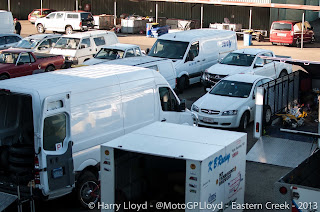
Australian Superbike is a lot like the racing of old. Small teams and working out of vans is almost exclusively what you see. There are no multi-story hospitalities or paddock scooters racing around with personal assistants, instead it’s a small team of mostly family members that help with the set up of the bike and cleaning leathers. Subsequently everyone is incredibly close. In GP there is a sense of family, almost everyone has been in the paddock for years and knows each other to some degree. But at ASBK it is taken to extremes, at the Eastern Creek round there were several teams who, for a variety of reasons, had a spare bike, bikes that they happily leant to competitors. Imagine Lorenzo lending Cal one of his M1s after Cal broke both of them.

Despite the small scale ASBK is highly professional. Frequent warning horns blast across the entire paddock, warning fans and staff that bikes are on the track and to be careful in pit lane. It’s grassroots racing at its finest. With a huge variety of classes from 250cc production bikes to Superbikes there is always a race or practice session on, it’s almost too much. The majority of races are also incredibly exciting because machinery and teams are on such a limited budget that it creates a very level playing field.

The level of access fans can get is also unrivaled. There’s no paying $500 for a paddock pass, the paddock is freely open to anyone. All the riders and team members are also extremely friendly and open to chatting and in some cases even showing fans around the pit box. This is a polar opposite to the strict rules fans must follow at a GP event and the teams who are too busy to talk to anyone. This open and friendly environment was more reminiscent of a local club race than a national series that produces world champions such as Mick Doohan.

ASBK is much more raw than MotoGP, it’s more pure. It might not have the big names that MotoGP has but ASBK was just as, if not more enjoyable. The racing was close and fierce, the riders all had personalities that were distinct and funny. Going to an event like this makes you think about why you watch the bigger series, is it for the racing, the personalities, the drama or a combination of all three? All of these can be found in national championships and on a much smaller, more personal level. This environment made for a much better overall experience than the somewhat sterile paddock that one encounters in MotoGP.

There's also the bonus of seeing the brothers, sisters and kids racing each other around the track and the paddock. Many a Goberts were seen, but sadly THE Go-Show was absent.

There are obviously advantages and disadvantages to smaller national series, but if you can’t attend a GP a local series, especially ASBK, is a great alternative and gives you a taste of the backstage action without the pressures of the more corporate and high tension Grand Prix circus.

Tuesday, October 9, 2012

Tom Sykes and Kawasaki Prove That There is Hope for Ducati and Their Myriad of New Talent


Kawasaki had, in years previous, been a team and a bike that struggled in championship racing, be it MotoGP or WSBK. At the end of 2008 they formally pulled out of MotoGP, leaving Marco Melandri to soldier on under the banner of the Hayate Racing Team in 2009, scoring a single podium in the mixed conditions of France, the odd wet podium had for a while been the best result any Kawasaki in any class could claim. 

Superbikes had been no better for Kawasaki as they struggled to score even the rare podium, the factory team often finishing mid back at best. But Kawasaki decided to change this, to focus more on the racing world. After the 2010 WSBK season the Kawasaki Ninja ZX-10R underwent extensive, race focused, development and in the hands of Tom Sykes managed a win. 2012 saw the Kawasaki become a WBSK title contender for the first time in over ten years and became competitive under the hands of not just Tom Sykes, but also Loris Baz. Tom Sykes would eventually lose the championship by just half a point, the closest ever margin in WSBK or MotoGP.

This stunning turn around of fortunes for Kawasaki prove that there is hope for Ducati, especially with the resources of Audi looming in the background. Similarly to Kawasaki Ducati to need make a change to return to the front of the pack as they had done with Stoner in his multiple years with the team. Ducati, and Audi, are willing to make the changes that are necessary and have enlisted four riders in the shape of Nicky Hayden, Andrea Dovizioso, Andrea Iannone and Ben Spies with wildly different riding styles in the hopes that one of their riding styles will ride the Ducati how it is meant to be ridden and provide a better base to make the Ducati more rideable, or at least show Ducati which riders to hire.

Ducati have shown this season that they are trying to improve the bike with a variety of swing arm upgrades for Rossi and Hayden, resulting in Rossi’s first dry podium at Misano earlier this year. This, combined with Audi’s support, sets hopes high that Ducati will be able to do what Kawasaki have done in WSBK and return to the front of the pack. The biggest hurdle they face is the creation and development of the chassis. This season Ducati had contracted out FTR to make their chassis as the small Bologna factory lacks the capacity to produce them at the rate required. Levels of worry about Ducati’s future raised earlier in the week when rumors began to circulate that Swiss chassis maker Suter had been in talks with Ducati about next season’s chasis. Suter have provide that their pace of development and chassis are somewhat lacking this season with their project in the CRT class, causing relations between Colin Edwards and Eskil Suter to become strained. 

There is no way to currently tell whether Suter will step up to meet a customer like Ducati or if there even is a deal. But the recent success of Kawasaki would suggest that by keeping the development in house, something that may become possible with the help of Audi, and by accepting radical changes that a struggling bike and team can turn around their fortunes, especially with a decent rider, in Ducati’s case four, leading development and riding the bike to the limit, that a change in fortunes is in-fact possible, especially for a team with a history of success like Ducati.